Let’s be honest for a second: most Shopify upsells are annoying.
You know the ones. You’re about to check out, and suddenly a giant box pops up asking if you want to add a slightly different version of what you just bought for 10% off. It’s the digital equivalent of someone stopping you at the grocery store exit to ask if you need extra batteries. It’s intrusive, it’s boring, and quite frankly, customers are getting really good at ignoring it.
If you’re still relying on those "traditional" upsells, you’re leaving money on the table. In 2026, the game has changed. Customers don’t just want products; they want an experience. They want to feel like they’re winning something, not just spending more money.
That’s where gamification comes in. By turning the shopping process into a game, you tap into deep-seated human psychology. You stop being a "store" and start being an "experience."
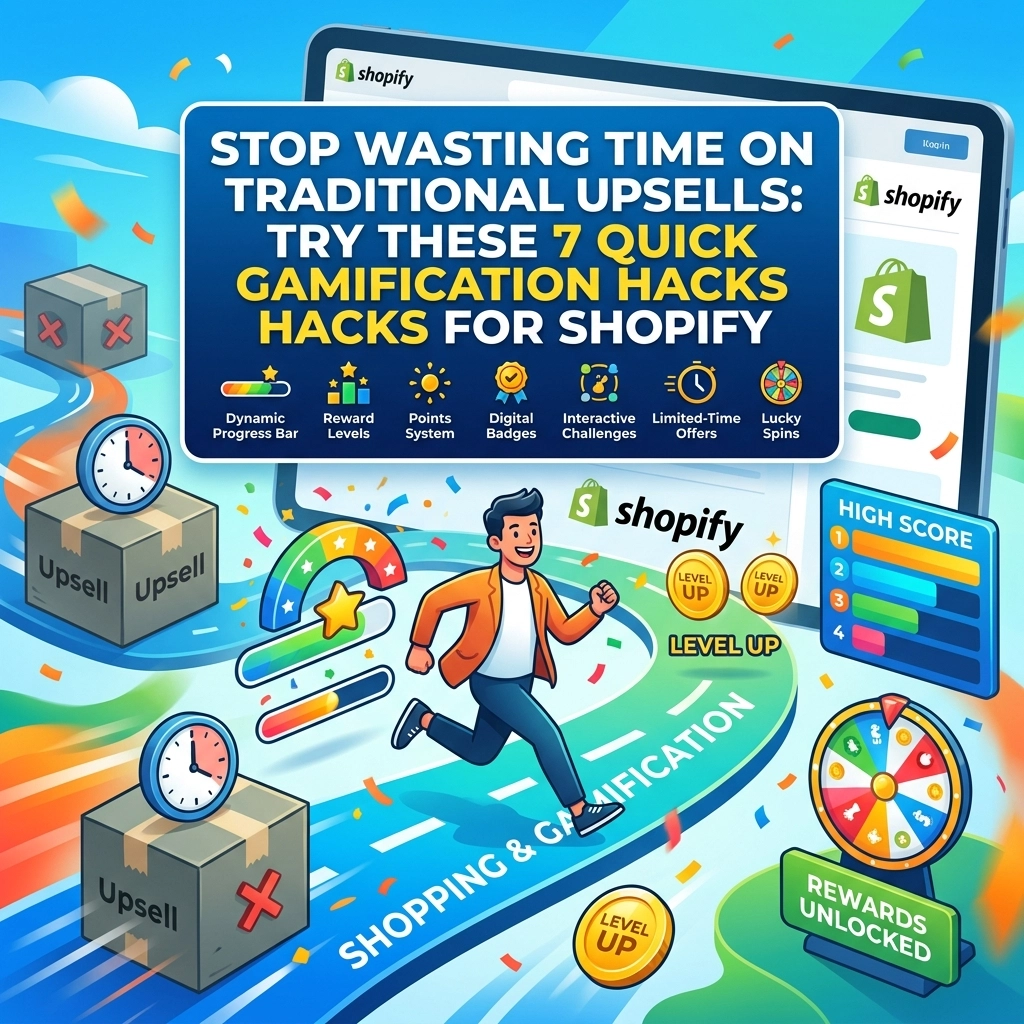
At Rafl, we’ve seen how shifting from transactional to interactive can skyrocket conversions and Average Order Value (AOV). Here are 7 quick gamification hacks you can use right now to fix your Shopify store.
The Psychology: Why Our Brains Love the "Win"
Before we jump into the hacks, we need to understand why this works. Gamification works because it triggers dopamine. When a customer interacts with a game: like a spin-to-win wheel or a progress bar: their brain treats it as a challenge rather than a sales pitch.
There’s also the "Variable Reward" theory. We are naturally more excited by a prize that might be big than a small discount that is guaranteed. This is why a chance to win a $10,000 prize often performs better than a boring $5 off coupon. It’s also why we built Rafl to handle massive giveaways: it taps into that "what if?" excitement that drives action.

1. The Revamped Spin-to-Win Wheel
You’ve probably seen these, but are you using them correctly? Most stores use them just to collect emails on the homepage. To use it as an upsell hack, try triggering it when someone adds an item to their cart.
Instead of a generic "Spin for 10% off," offer prizes that scale with their cart value.
- The Hook: "You’re $20 away from a Platinum Spin!"
- The Result: Customers add that extra item just to get a better shot at a bigger prize.
Research shows that interactive wheels can convert up to 11% of visitors. That’s massive compared to the standard 1-2% for static popups.
2. "Unlockable" Tiered Progress Bars
This is one of the simplest but most effective hacks for increasing AOV. Most stores have a "Free Shipping at $50" note. That’s fine, but it’s not a game.
A gamified version uses a visual progress bar in the slide-out cart. As the customer adds items, the bar fills up.
- Level 1: Free Shipping.
- Level 2: Free Mystery Gift.
- Level 3: Entry into a $1,000 Cash Giveaway.
By making it visual, you’re utilizing the "Goal Gradient Effect." The closer someone gets to a goal, the harder they work to achieve it. Watching that bar get to 90% and then finding a $5 item to finish it off is a satisfying user experience.

3. Product Recommendation Quizzes
Stop making people browse your entire catalog. It creates "choice paralysis," where they get overwhelmed and leave. Instead, use a quiz.
A quiz is a game where the prize is the perfect product.
- "What’s your skin type?"
- "How much time do you spend in the sun?"
- "What’s your budget?"
At the end, don’t just show them one product. Show them a "Routine Bundle" and offer a limited-time "Quiz Finisher" discount. It feels personalized, and because they invested time into the quiz, they are significantly more likely to buy.
4. Mystery Boxes and Digital Unboxing
Humans are curious by nature. The "Mystery Box" hack works by offering a product at a discount where the customer doesn't know exactly what they’re getting until it arrives: or until they "unlock" a digital reveal at checkout.
You can add this as a "one-click upsell" after they’ve already made a purchase.
"Wait! Want to add a Mystery Accessory for only $15? (Valued up to $40)."
It’s a low-friction way to clear out inventory and give the customer a fun surprise.
5. Falling Gift Catching Games
This is a high-energy engagement hack. Imagine a customer is about to leave your site (exit-intent), and suddenly, virtual gift boxes start falling down the screen. They have 5 seconds to click on one.
When they click, they "catch" a prize. It could be a discount, or better yet, an entry into a major Rafl giveaway. Because it requires quick reflexes and active participation, it breaks the "zombie scrolling" habit and refocuses them on your brand.
6. The "Daily Streak" Loyalty Program
Traditional loyalty programs are boring. You buy stuff, you get points, you forget about the points.
Instead, try a "Streak" system. If a customer visits your site or engages with your social media 3 days in a row, they unlock a special "Secret Menu" of products or a higher-tier prize entry. This builds a habit. Once someone has a 5-day streak, they don't want to lose it. This keeps your store top-of-mind without you having to spend a fortune on retargeting ads.

7. The Ultimate Hack: High-Stakes Rafl Giveaways
If you want to move the needle on your conversion rate and CAC (Customer Acquisition Cost), you need to think bigger than 10% coupons.
This is what we do at Rafl. Instead of a tiny discount that eats into your margins without much excitement, you offer your customers a chance to win life-changing prizes. We’re talking $10k, $50k, or even $1M+.
Here’s why this is the king of gamification:
- The Psychology: The perceived value of a $1,000,000 prize is infinitely higher than a $5 discount, even if the odds are different.
- The Margin: Rafl operates on a 50/50 revenue share model. You don't have to put up the prize money yourself. You simply integrate the Rafl app, and for every "entry" or gamified interaction, the revenue is split.
- Lower CAC: People share giveaways. They don't share "10% off" coupons. Your customers become your marketing team because they want their friends to see the cool game they're playing.
You can check out how this works on our main page or dive into the Merchant Terms to see how easy it is to get started.
Why Shopify Merchants are Switching to Gamification
Traditional upsells are a race to the bottom. If your only lever is "lower price," you’re eventually going to run out of margin. Gamification allows you to compete on excitement and value.
When you use a tool like Rafl, you aren't just adding a popup; you’re adding a revenue stream. You’re taking the boring parts of e-commerce: the checkout, the cart, the email sign-up: and turning them into a high-stakes, fun environment.
The Benefits at a Glance:
- Lift in AOV: Customers spend more to "unlock" rewards.
- Higher Conversion Rate: The "fear of missing out" on a big prize drives immediate action.
- Customer Retention: People come back to check on their entries or continue their streaks.
- No Margin Drain: With Rafl’s 50/50 split, you aren't just giving away your profits. You’re building a sustainable prize-driven ecosystem.

How to Get Started
You don't need to implement all 7 of these tonight. Start with one.
If you want the biggest bang for your buck, look into a plug-and-play solution. Shopify is great, but it doesn't have these features built-in. You’ll need a specialized app.
If you’re ready to stop playing small and start offering prizes that actually get people talking, sign up for Rafl today. We handle the legal stuff (like the Alternative Method of Entry), the prize pools, and the tech. You just focus on selling your great products.
The era of the boring upsell is over. It’s time to let your customers play.
Want to learn more about our team? Check out our About Us page or see who's behind the scenes on our author page.
Keep reading
Checkout Gamification: Analysis of 100+ Shopify Stores Using Sweepstakes to Reduce Cart Abandonment
May 21, 2026
Shopify Prize Indemnity: Insurance Costs, Payout Odds, and Legal Compliance for $100k+ Giveaways
May 19, 2026